
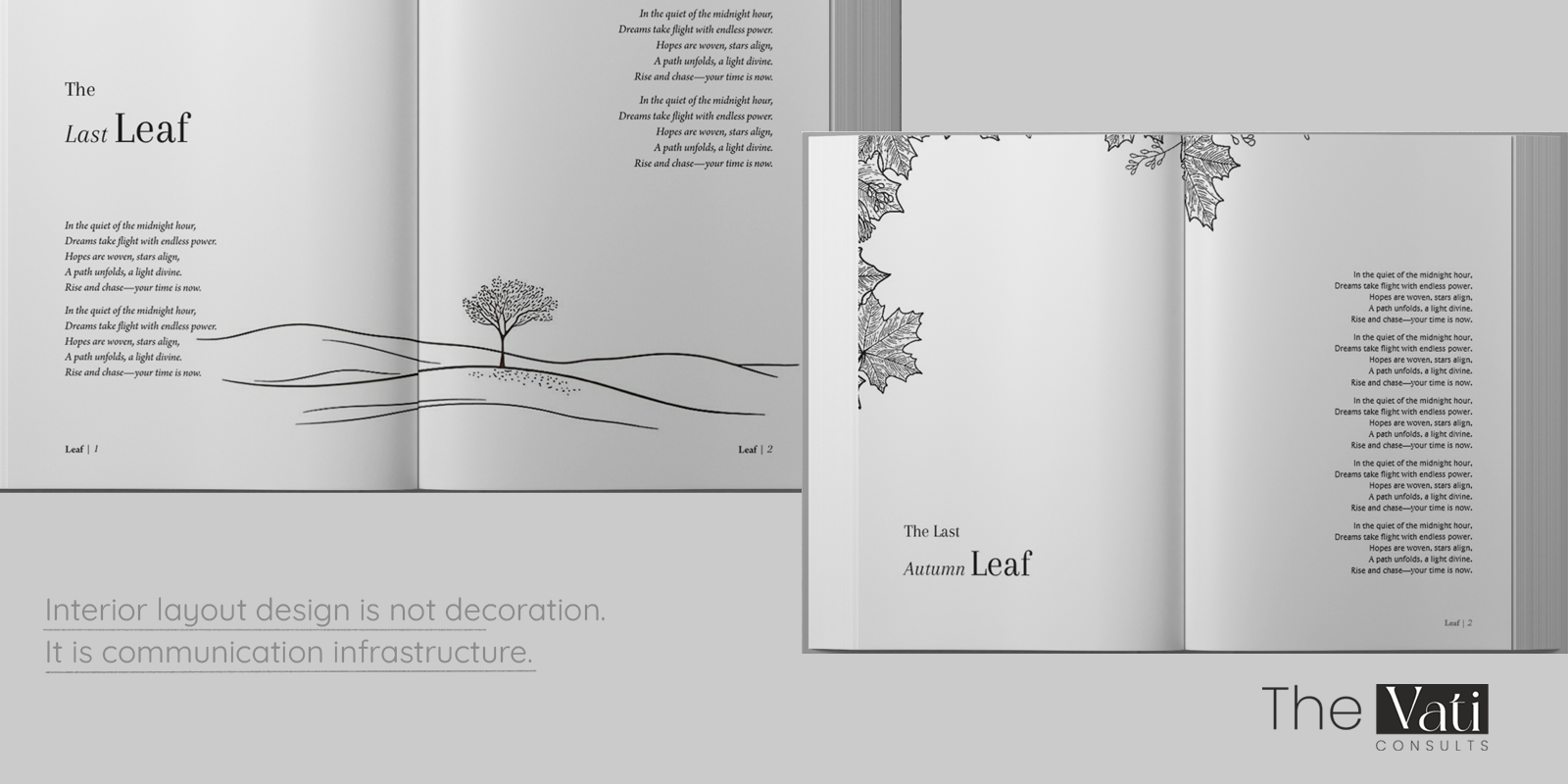
The Cover Gets The Reader To Open The Book. The Interior Layout Determines Whether They Ever Want To Pick It Up Again.
The purpose of interior layout is not to make a publication look beautiful — though a well-laid-out publication is beautiful. The purpose is to make the act of reading feel effortless. Every decision in the layout exists in service of that single goal: removing friction between the reader and the text.
Typography is where this starts. The choice of typeface for body text is not a stylistic preference — it is a functional decision. A typeface designed for extended reading has specific characteristics: open counters, generous x-height, balanced stroke contrast, and spacing that allows the eye to move across a line without strain.
Using a display typeface for body copy, or a typeface optimised for screens in a print book, introduces friction the reader will feel as fatigue within a few pages, even if they cannot name what is causing it.
Line length matters in the same way. The optimal measure for comfortable reading is between sixty and seventy-five characters. Lines shorter than this force the eye to change direction too frequently. Lines longer than this cause the eye to lose its place.
Leading — the vertical space between lines — is equally consequential. Too tight and the text feels dense and airless. Too loose and the relationship between lines breaks down.
One Format. Very Different Demands.
Interior layout is not a single discipline with one set of rules. Books, journals, magazines and catalogues each present a fundamentally different reading experience.
A novel demands long-form immersion. A research report demands information hierarchy. A journal demands structured navigation. A catalogue demands visual scanning.
Each requires its own approach to typography, spacing, hierarchy and navigation.
Layout Is Invisible When It Works
Readers rarely compliment a good layout because they rarely notice it. Instead, they experience clarity, flow and comfort.
The best interior design disappears behind the content, allowing the ideas to take centre stage.
Conclusion
Interior layout design is not decoration. It is communication infrastructure.
Whether the publication is a book, annual report, research journal or knowledge product, layout directly influences readability, comprehension and engagement.